

New-generation headlamp technology – light distribution to match driving and weather conditions
Mercedes-Benz unveils the Intelligent Light System, a new generation of adaptive car headlamps which is now entering series production.
These adapt to the prevailing driving and weather conditions, thereby significantly enhancing safety.
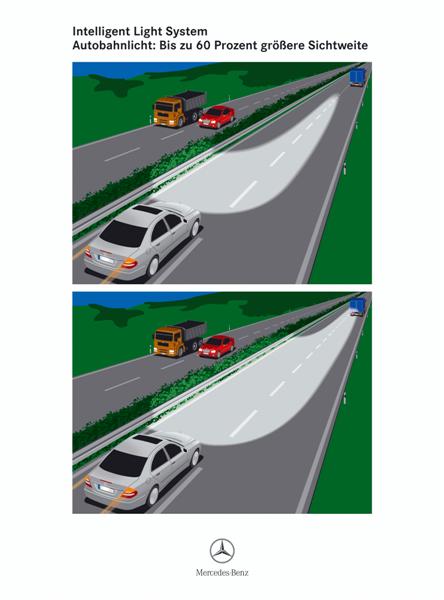
New lighting functions such as country and motorway light modes increase the drivers range of visibility by up to 50 metres.
The Intelligent Light System also includes the active light and cornering light functions, as well as new, enhanced fog lamps which illuminate the road edges and therefore provide even better orientation when visibility is poor.
The new, intelligent headlamps are a continuation of many years of effort by Mercedes-Benz to make driving safer at night.
Despite the lower volume of traffic, the risk of a serious accident is twice as high during the hours of darkness as it is during the daytime.

[adsense]
The lighting system incorporates variably controllable headlamps with five different light functions.
Mercedes-Benz plans to combine the Intelligent Light System with the bi-xenon headlamps offered as an option in the E-Class, becoming the first manufacturer to provide its customers with the best lighting technology currently available.

In the E-Class Mercedes-Benz has upgraded its bi-xenon low-beam headlamps with their highly effective, asymmetrical light distribution into a new country mode which illuminates the left-hand edge of the road more widely and brightly.

The drivers range of vision is increased by around ten metres, which gives him better orientation in the dark and allows him to respond more rapidly when other road users cross his path.

Far-reaching: new motorway mode with longer range
From a road speed of 90 km/h the new motorway mode is automatically switched on in two stages: in stage one the output of the xenon lamps is increased from 35 to 38 watts, and in stage two the range of the nearside headlamp is increased when a speed of 110 km/h is reached.
[adsense]The result is a uniform cone of light which illuminates the entire road width to a range of up to 120 metres.
At the centre of this cone the driver is able to see around 50 metres further than with conventional low beams, which allows him to recognise vehicles, even at very long distances, and adapt his driving style accordingly.

The enhanced fog lamps, which are also part of the new Intelligent Light System, provide better orientation in adverse weather conditions.
If visibility becomes less than 50 metres, the vehicle speed falls below 70 km/h and the driver switches on the rear fog lamp, the left bi-xenon headlamp of the E-Class swivels outwards by eight degrees and, at the same time, lowers the cone of light.
This illuminates the nearside of the road more efficiently, while the wider beam reduces backglare in fog. The enhanced fog lamps remain switched on up to a speed of 100 km/h.

The active light function, which Mercedes-Benz first offered in the E-Class in spring 2003, has been developed further by the engineers in Sindelfingen.
The swivel angle of the headlamps has been increased from 12 to 15 degrees, providing even better illumination on tight bends.
With the active light function, which operates at both low beam and main beam, the bi-xenon headlamps automatically follow the steering angle.
Road illumination is improved by up to 90 percent when negotiating bends.

The Intelligent Light System also includes the cornering light function, in which one of the two fog lamps is automatically switched on when the driver operates an indicator or turns the steering wheel.
As a result, the range of side visibility ahead of the vehicle is increased by around 30 metres. The cornering light function is activated up to a speed of 40 km/h.
Active Light System
The headlamps follow the steering movements.
Interior: ambient lighting as a safety factor

In addition to the new Intelligent Light System, the Mercedes-Benz E-Class also offers a unique lighting concept in the interior: ambient lighting, which provides effective yet discreet and glare-free illumination of the interior for driving at night.
The system incorporates light-emitting diodes (LEDs) in the door handle recesses and footwells, as well as special luminous panels in the roof liner.
This means that the sense of spaciousness and the high quality of the interior can also be appreciated by night.

The E-Class is the only car in its market segment to feature such a sophisticated and well-conceived lighting concept for the interior.
It not only ensures a particularly pleasant interior lighting mood, but also enhances the drivers operating and perceptive safety during the hours of darkness.
This is because the permanent interior lighting lends better visual support to control processes and allows easier recognition of the switch arrays in the centre console.
It also reduces the need for the eyes to adapt to the difference in brightness between the vehicle interior and the road, which means less strain on the eyes and therefore less rapid fatigue.

Furthermore, a pleasant “visual atmosphere” makes a major contribution to driver-fitness safety because the ambient lighting has a psychologically and biologically stimulating effect on the driver and therefore improves his performance potential.

Outlook: high-performance LEDs for the car headlamps of the future
In the future Mercedes engineers plan to implement the new lighting functions of the Intelligent Light System with the help of LED headlamps.
They expect that in a few years time, white multi-chip LEDs will be capable of delivering the same output as todays xenon lamps.

In addition to a lower space requirement and a very long service life, LEDs have further advantages for vehicle lighting.
If several LEDs are connected in series to form arrays, each individual LED can be separately controlled to adapt the light distribution to suit the current driving situation in fractions of a second.
This will make lighting functions such as motorway mode, the active light function and the cornering light function possible by purely electronic means.

Moreover, the extremely rapid response of LEDs allows an innovative, adaptive main-beam function which Mercedes engineers are currently testing in practical trials.
A camera behind the windscreen registers oncoming vehicles and calculates their distance.
An electronic control unit uses this information to dip the main beam as required. In this way technology resolves the conflict of aims between prevention of dazzle and the best possible range of visibility.
LEDs will also be able to perform additional tasks when used as brake lights. Mercedes engineers plan to use these rapid light signals to transfer data as well.
Their light impulses can e.g. provide information about the actual braking deceleration of the vehicle ahead.
The Brake Assist system can then use this to adapt the brake pressure to suit the individual situation. In this way the technology of the future can help to prevent rear-end collisions.

Optimum vision

| Realistic tests confirm that motorists who use Adaptive Highbeam Assist are safer on the road in the dark: dummies placed at the side of the road to simulate pedestrians were detected from a distance of around 260 metres – around 150 metres earlier than is the case when conventional low beam is used – despite the presence of oncoming traffic. What’s more, the system relieves driver stress as there is no longer any need to repeatedly flick the stalk on the steering wheel. So the driver can concentrate more on actually driving the car. Once activated, Adaptive Highbeam Assist always provides the best possible headlamp range. | ||||||||


Mercedes-Benz MULTIBEAM LED headlamps: Mercedes-Benz MULTIBEAM LED headlamps with a gridded light source containing 84 LEDs, enabling even higher resolution of the light output.

High-resolution LED headlamps
Let there be light
The future E-Class with enhanced MULTIBEAM LED headlamps opens up new dimensions in headlamp technology.
Each headlamp is now equipped with 84 individually activated high-performance LEDs rather than 24, meaning that they are exceptionally bright and precise, and automatically illuminate the road surface with a previously unsurpassed, precision-controlled distribution of light – without dazzling other road users.
Advances in lighting technology are a tradition at Mercedes-Benz: around 500 LEDs attended to all the lighting functions on a car for the first time on the S-Class in 2013.
In 2014 Mercedes-Benz unveiled new MULTIBEAM LED headlamps with precision LED grid modules in the CLS, to make night-time traffic safer for all road users.
The statistics show just how important such precision lights are: at night-time, the risk of accidents increases drastically. At night on rural roads there are basically around five times as many accidents with serious consequences as during the day.
Although night-time driving on this category of road only accounts for 20 percent of total mileage, this is when and where 40 percent all of all fatal accidents occur (source: BASt, German Federal Office for Roads and Traffic).
Unlike the MULTIBEAM LED headlamps on the CLS, which each feature 24 individual high-performance LEDs, the next generation on the new E-Class uses a newly developed, high-resolution precision LED module as a grid light source, fitted with 84 high-performance LED chips.
This is able to react even more dynamically, and the light illuminating the road is high-resolution and even more precise.
Each one of these LEDs can be individually electronically controlled. “Gridding” the light in this way allows the light distribution from the right and left headlamps to be controlled entirely separately and adapted to the traffic conditions with a high level of dynamism.
This enables the individual areas of the road surface to be illuminated in a very specific manner.
When it comes to the number of pixels, the same is true of LED headlamps as of a monitor: the higher the number of individually controllable pixels, the higher the resolution and the finer the displayed image.
A high number of pixels also allows greater dynamism in the display. In terms of perception, this leads to a clear increase in precision and brilliance.
With 84 LEDs per precision module, the headlamps on the new E-Class allow the resolution of the light pattern to be increased by a factor of around 3.5. As a result, other road users can be protected more precisely against dazzling, and back-glare can be more effectively avoided.
This new dimension of precision when it comes to light distribution allows longer use to be made of the partial main-beam lights, increasing safety.
The driver also benefits from improved illumination of the road. Compared with the systems prevalent on the market today, the MULTIBEAM LED headlamps have up to 2.5 times the partial high-beam light output.

Blue fascination
The 2nd generation MULTIBEAM headlamps are instantly recognisable. They provide new and surprising visual highlights with passively illuminated, blue light surfaces.
These outline the hallmark E-Class “torch effect” daytime running lamps and side lights and, even when low beam or high beam is switched on, create a pleasant blue setting for a fascinating look.
This design does not irritate other road users in the slightest thanks to the clever arrangement of the lighting elements. It gives the light design of the E-Class an unmistakable character.

New safety-enhancing functions
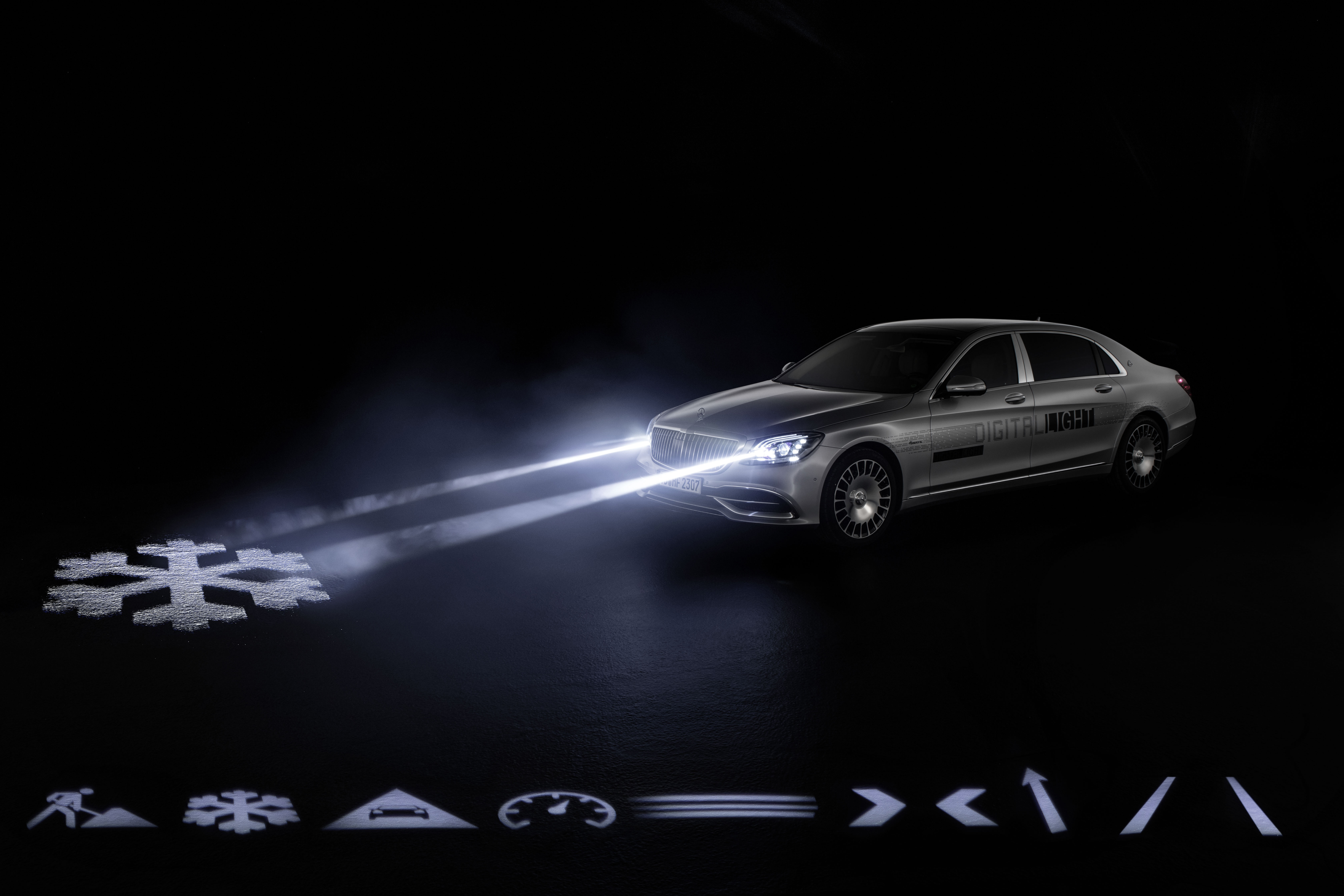
As a result of the completely freely configurable high-resolution light distribution, it is possible for the first time to implement all high and low-beam functions of the Intelligent Light System in entirely digital mode and without any mechanical actuators in the new E-Class.
As a world first, the dynamic cornering light function is purely electronic. In addition a wealth of new, adaptive light functions are possible which will render night-time driving even safer for both the driver and other road users.
The newly developed adverse weather light function reduces reflections on the oncoming lane when it is raining by specifically dimming individual LEDs and actively helps prevent indirect dazzling of oncoming traffic.
The city light function provides the driver with particularly wide light distribution when driving at low speeds and on lit roads in built-up areas, brightly illuminating difficult-to-see pavements and danger zones.
Data from the navigation system is not only used for the roundabout light function, familiar from the CLS, but can also now be used to detect junctions and motorways and to adapt the light distribution automatically to suit these.
Adaptive Highbeam Assist Plus has also been further optimised: thanks to a larger number of pixels, the dark areas in the light distribution are more precise and dynamic than ever before in partial main-beam mode, and the main beam can be used for longer than before.
A camera on the windscreen supplies the system with the information it needs about the constantly changing traffic situation and is also used by other assistance functions.
Four control units per vehicle calculate the ideal light pattern 100 times per second and activate all 84 high-performance LEDs in each precision grid module individually.
The added safety provided by the MULTIBEAM LED technology becomes apparent above all in real traffic situations: in contrast to static high-beam systems, some of which have long ranges, MULTIBEAM LED also supports the driver when there are other vehicles in the field illuminated by the headlamps.
Because it masks these out of its light distribution specifically within a fraction of a second, it is possible to drive with main beam switched on at all times.
This assures the driver of the best possible light performance at all times, without dazzling other road users.

Advantage: LED
The LED technology used for the MULTIBEAM headlamps offers further advantages: by way of example, the light from the bright LED headlamps is almost the same colour as daylight and therefore in line with normal human perception patterns.
Studies have shown that the closer the colour of artificial light is to daylight, the less the strain on the eyes. With a colour temperature of 5500 kelvin, LED light is closer to daylight (6500 K) than xenon headlamps (4200 K).
The 84 high-performance LEDs in the MULTIBEAM LED headlamps also help to increase efficiency thanks to their high lumen output/wattage and are designed to last for the entire vehicle lifetime.
Safety benefits of LEDs in tail lights too: brightness rather than glare
The new E-Class will again feature tail lights with the familiar Mercedes-Benz multi-level functionality – functionality that remains unique in the car industry.

The brake lights and indicators are operated with varying light intensity, depending on the driving situation and ambient lighting (day/night).
If the Mercedes driver presses the brake pedal while stopped at traffic lights at night, for instance, the brightness of the brake lights will be automatically dimmed to avoid dazzling anyone behind.
It goes without saying that the lights still comply with all statutory requirements.
During the development phase, light experts at Mercedes-Benz carried out experiments at a testing ground, simulating real traffic situations. The tail lights of the test vehicle were operated with varying intensity at different times of the day and under different light conditions, and the brightness and density of the light were measured.
With the aid of these values, glare at a specified minimum light intensity was reduced to the desired level.